Spotlight | Oki’s Movie (Hong Sang-soo, South Korea)
By Andrew Tracy
Much of the best cinema today almost seems discontent with the idea of being only cinema—or “cinema” in the sense of an immersive narrative world contained within the durational boundaries of a single feature film. The distrust of classical narrative evidenced by many of the best contemporary filmmakers corresponds with their efforts to make their films rhyme, resonate with, or bounce off other spheres outside the film’s narrative universe, whether through multi-part works, reflexive meta-cinematics, or the Herzogian gambit of making the fiction (insofar as it is a photographic record of people performing certain actions) essentially a documentary of its own making. Repetition with variations, that time-tested template for artistic creation, is still very much the mode these days, but with a heightened self-consciousness as to the act of repetition—and, perhaps, an intimation of its potential sterility. “Film as an art is finished,” says Professor Song (Moon Sung-geun) to his former student, now struggling filmmaker-in-residence Jingu (Lee Seon-kyun) shortly into Hong Sang-soo’s Oki’s Movie. “It can’t go back to how it was…Let’s just read. In such a rotten world, only books will save us.”
For Hong, whose oeuvre is perhaps one of the most ostentatiously repetitive in contemporary cinema, such explicit baring of the device seems about the only avenue left for him to simply keep working in his chosen mode. Happily, Oki’s Movie—premiering as the closing film in Venice’s Orrizonte section before playing in Toronto, where it is curiously unaccompanied by its immediate predecessor, this year’s Un Certain Regard winner Hahaha—not only sustains the pertinence of Hong’s cinema but refracts it through an extra-cinematic device. In Hahaha, Hong repeated and jumbled the fiction by having two inebriated buddies tell each other a story, without the awareness that they are narrating the recent pasts of the same characters. In Oki’s Movie, as per Song’s seeming dismissal of cinema, Hong is even more daring, employing an almost novelistic (in structure rather than scope) narrative frame, which adds intriguing layers to the film’s triangular scenario while also blithely admitting its inauthenticity. “Starting with a theme will make everything veer toward one point…It’s no fun pouring all things into a funnel. That’s too simple,” Hong’s deceptively deployed pseudo-vicar Jingu says at one point; but Hong’s sly double game allows him to have it both ways. Tight and refreshingly brief (a brisk 80 minutes), Oki’s Movie functions as both reflexive auto-critique and an elegantly crafted cinematic/literary object bearing an all-too-pointed theme.
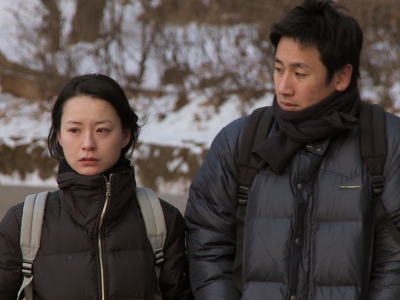
Divided into four sections potentially capable of functioning as self-contained shorts—each with its own (identical) title sequence, each using Elgar’s first Pomp and Circumstance march to nicely ironic effect—the film charts a love triangle between the two men and their mutual object of desire, Oki (Jung Yumi), a young film student who carries on a secret affair with the older professor while eventually (and a tad inexplicably) succumbing to Jingu’s earnest, pathetically dogged advances. With the mutual courtships and complications enacted via bouts of heavy daytime drinking, mildly humiliating public displays, and patently unwise sexual decisions, this is more-than-familiar territory for Hong: the games men play (witting or not), the women they victimize, and the mysterious tenacity which carries those women past these damaging encounters, leaving the men stuck in the morass of their own making.
What gives Oki’s Movie an added charge is announced in the title itself: beginning as another up-close portrait of male vanity, neediness, and narcissistic despair, it subtly shifts across the four movements to deposit narrational control into the hands of the woman who had been the vehicle of this narcissism. Taking place four years after the film’s primary story, the first segment “A Day for Chanting” finds an embittered, perpetually inebriated, and unhappily married Jingu slothfully trying to make ends meet as a sessional film instructor at his old alma mater. Pitifully holding on to his reverence for Song—even as the older man’s ethics are called into question by rumours that he sold a tenureship coveted by Jingu to a fellow instructor—Jingu seems to cling to this shallow worship (and Song’s veiled scorn for him) almost as a kind of inverted mirror of his own abasement. During a Q&A after a sparsely attended screening for the short film he made while studying with Song, Jingu is suddenly assailed by a question from a young woman who claims that he had dated a friend of hers four years previously while he was married, then dumped her, ruining her life; when he upbraids her for asking personal questions when they should be talking about film, she replies, “Your film is just about you. And we pay money to see it. So what should I be asking?”
A neatly ironic point, and Jingu’s evasions and self-pity (“When I became a director all kinds of rumours started flying around…I’m not making films anymore, satisfied? I didn’t make films for people like you”) could easily be left as is, another specimen in Hong’s gallery of homo miserabilis. “King of Kiss,” the second movement, initially seems to cement this as it shuttles back four years to a more optimistic but no less drunken Jingu as he desperately and pathetically courts the initially unresponsive Oki by coercing her into midday drinking sessions and staking out her apartment stairs for a long, cold night. Palpably bruised when his short film, which had been praised to the skies by Song, fails to win the top prize in the school’s film contest (a mirror of the tenureship he fails to secure in the film’s first section), Jingu’s frantic pursuit of Oki could be read as a displacement of his frustration. And even though Jingu is wholly unaware of Oki’s dalliance with Song, the unspoken, passive-aggressive grudge between the two men—Song’s jealousy being naturally ignited when Oki informs him of Jingu’s romantic overtures—finds its crystallization in their mutual pursuit of her.
Though amusedly indignant at her situation (“Everybody suddenly seems to be falling in love with me,” she confides to a friend), Oki still seems very much a pawn in these games, her signs of weakness—a propensity for the bottle, and her final, helpless surrender to Jingu’s idiotic advances—setting her up for a fall. Yet as the film enters its fourth and final segment—aptly dubbed “Oki’s Movie” and narrated in her own voice—it becomes evident how much control she exerts over her two suitors. Over the course of two days she takes each man, unbeknownst to the other, for a hike along the same mountain trail, coolly assessing their respective demeanours, their differences and similarities, and her own emotional reactions to them.
Subtly and elegantly, Hong here executes a telling power shift and a pointed thematic articulation. Previously the narrative centre of the film, Jingu and Song are now essentially subjected to an audition. These men who had both decried the insidiousness of rumour—who had refused to allow themselves to be defined outside of their own self-conceptions—are now made variables in an experiment conducted by the previously passive embodiment of their respective narcissisms. Though neither disinterested, unsympathetic, or vindictive, Oki nonetheless reverses her position as projection or ideal and turns that evaluative gaze back upon her pursuers—and in the film’s final, perfectly deployed line of meta-cinematic narration, she deprives both of even the sovereignty of their narcissism, reducing their documented torments over the past 80 minutes to shadowplay.
However, there’s nothing cruel or glib about this final rug-pulling. Even as he undermines his own meticulously constructed artifice, Hong only attests to that artifice’s insight and power. From behind his veil of irony and deceptive self-confessions, Hong clearly regards cinema as a profoundly moral instrument; not merely a narrative ploy, his reflexiveness is a means of widening the film’s sphere of implication. In the central scene of the film’s third movement, Oki and Jingu bombard Song with questions in an empty classroom: “Do you think I have any talent in film?” “Keep making films and you’ll find out.” “Am I a good person?” “To somebody.” “What do you want most?” “Well, I want this today, and I want that tomorrow…In life, of all the important things I do, there’s none I know the reason for.” To the extent that we can take anything Hong “says” at face value, this would seem to be an at least tentatively reliable index of his beliefs: that the thing that most interests him—the maddening unknowability of our own selves—is inseparable from his decision to portray it on film, over and over again.

Support